Draft.js vs Tiptap: Which Rich Text Editor Is the Best Choice for React Developers in 2025?
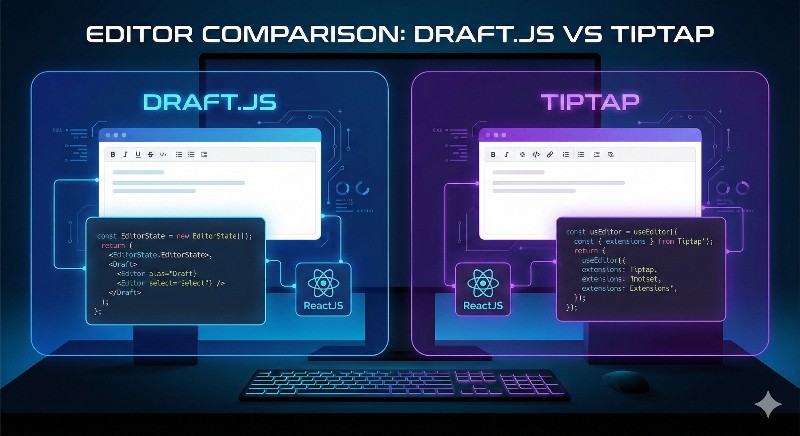
Let’s be honest: building a text editor from scratch is one of the fastest ways to lose your sanity.
If you’ve ever tried turning a simple <textarea> into something that can support bold, italic, headings, and maybe even an image upload, you know exactly what I mean. You start the day full of confidence… and end it fighting unpredictable cursor jumps, browser quirks, and event-handling nightmares. Safari alone can make you question your career choices.
React developers don’t want to deal with that chaos. We want libraries that handle the frustrating parts so we can focus on shipping real features. For many years, the go-to answer for this was Draft.js — Facebook’s open-source rich text framework. It powered major products, and for a long time, it was the “safe choice.”
But today, the community is buzzing about a newer contender: Tiptap, a modern, powerful, developer-friendly editor built on top of the legendary ProseMirror engine.
So the question is…
If you’re starting a project in 2025, should you choose Draft.js or Tiptap?
Is Draft.js outdated?
Is Tiptap overhyped?
Or is one of them clearly the better choice?
Let’s break this down — developer to developer — and look at the real differences that matter in modern React applications.
Before We Compare: What Do React Developers Actually Need in a Rich Text Editor?
A modern editor is more than bold and italic buttons. Today’s apps (blogs, CMS platforms, chat apps, dashboards, documentation tools) expect features like:
Embeds — images, videos, code blocks, tweets, etc.
Mentions —
@usernametagging like Reddit or SlackSlash commands —
/to open a quick action menu (Notion-style)Markdown shortcuts — type
#to create a headingCollaboration — real-time editing, Google Docs style
Clean data output — save as HTML or JSON, not unreadable text blobs
And because React wants to control the DOM while contenteditable wants to control the DOM, editors must handle state efficiently, without causing weird bugs or performance drops.
With that in mind, let’s look at the two players.
Draft.js — The Old Guard
A Quick History Update
Draft.js was created and open-sourced by Facebook back in 2016. At the time, it was revolutionary — a reliable, structured way to build editors in React. It used Immutable.js to tightly manage state and gave developers full control over the formatting logic.
Many huge apps adopted it, and it became the “standard choice” for years.
But in 2025… things look different.
How Draft.js Works (and Why It's Hard Today)
Draft.js uses a highly structured internal state model. It doesn’t trust the browser at all. Instead, it tracks every character, every block type, every entity, and forces the DOM to match its internal representation.
This approach was powerful, but today it feels heavy and outdated.
Major Problems with Draft.js in 2025
1. The Learning Curve Is Rough
You need to understand:
Entities
Decorators
Block types
Immutable.js structures
It’s a lot — especially for beginners.
2. Almost Everything Requires Plugins
Want mentions? Plugin.
Want emojis? Plugin.
Want a toolbar? Plugin.
Want bug fixes? Good luck.
Most plugin libraries aren’t actively maintained anymore.
3. Mobile Support Is Weak
Draft.js historically struggles with:
Android predictive text
Mobile cursor handling
Input lag
These issues have been open for years.
Is Draft.js Still Maintainable?
Facebook is not actively evolving Draft.js. They’ve internally moved toward Lexical, their new editor framework (another strong competitor, but not React-first like Tiptap).
Tiptap — The Modern Challenger
Now let’s talk about the editor everybody is obsessing over.
Tiptap is built on ProseMirror, widely considered the most advanced editor engine on the web. ProseMirror is extremely flexible but hard to use directly.
Tiptap solves that by wrapping ProseMirror in a clean, React-friendly API.
The Core Philosophy
Tiptap is headless.
That means:
It gives you the logic
You build the UI however you want
No forced themes
No forced toolbar
No DOM constraints
React developers love this because it feels natural — you control markup through React components, not through HTML injected by the library.
Why Tiptap Feels Like the Future
1. It Feels Native to React
You can spin up an editor like this:
const editor = useEditor({
  extensions: [StarterKit],
  content: "<p>Hello World</p>",
});
That's it. No weird mental overhead.
2. Styling Is Actually Easy
Want Tailwind styling?
Want a floating bubble menu?
Want a custom toolbar?
Tiptap encourages customization instead of fighting against it.
This is especially helpful if you're using Next.js, Tailwind, shadcn/ui, or building a CMS-like interface.
For a deeper example of a modern clean setup, you can check this practical guide:
👉 Why Choose Tiptap for a Markdown & Rich Text Editor?
(It’s referenced naturally, so it fits perfectly into a Tiptap-focused section.)
3. JSON Output That Actually Makes Sense
Draft.js outputs complicated Immutable.js blocks.
Tiptap outputs clean JSON or clean HTML.
This is better for:
Databases (MongoDB, Postgres, Supabase, Firebase)
Server-side rendering
Static site generation (Next.js)
SEO content rendering
4. The Ecosystem Is Alive and Growing
Official extensions include:
Slash commands
Tables
Images
Mentions
Collaboration
Highlighting
Task lists
Typography rules
Markdown
Draft.js can’t compete with that level of official support today.
5. Real-Time Collaboration That Actually Works
Tiptap has Hocuspocus, a backend server for collaborative editing based on Y.js. This makes Google-Docs-style editing very achievable.
Draft.js collaboration?
Only possible with custom hacks.
Performance Comparison
Here’s the truth:
Draft.js slows down with big documents.
Typing lag becomes noticeable.
Mobile performance drops fast.
Rendering large blocks takes time.
Tiptap (via ProseMirror) is extremely optimized.
It updates only the part of the DOM that changes — nothing more.
This is why editors like Notion, Atlassian, and many major apps rely on ProseMirror derivatives.
Draft.js vs Tiptap (Side-by-Side)
| Feature | Draft.js | Tiptap |
|---|---|---|
| Release Year | 2016 | 2020 (modern) |
| State model | Immutable.js | JSON + ProseMirror |
| Learning curve | High | Beginner-friendly |
| Mobile support | Poor on Android | Strong |
| Customization | Difficult | Easy, headless |
| Community | Stale | Growing rapidly |
| Extensions | Mostly third-party, outdated | Official, well-maintained |
| Collaboration | Not built-in | Built-in with Hocuspocus |
| Next.js support | Basic | Excellent |
| Use cases | Legacy systems | Modern apps, CMS, dashboards, editors |
Real-World Scenario: Building a Blog CMS
Draft.js experience
Takes a lot of code to get basic formatting
Hard to style content blocks
Complicated when saving HTML
Image support requires plugins
Tables are painful
Draft.js HTML output often breaks in SSR
Tiptap experience
Easy setup
Built-in toolbar examples
Image upload works smoothly
Tables, mentions, tasks — already provided
editor.getHTML()gives clean outputWorks well with static rendering in Next.js
This difference matters a lot for real React projects.
Which One Should YOU Choose?
Choose Draft.js only if:
You’re maintaining a legacy app
Your codebase is already heavily integrated with it
Otherwise, there is no strong reason to use Draft.js in 2025.
Choose Tiptap if:
You want a modern, clean, React-friendly editor
You’re building a CMS, blog, chat app, or dashboard
You need Markdown support
You want a Notion-style interface
You want collaboration features
You need good Next.js compatibility
You want Tailwind or custom UI styling
In other words:
Tiptap is the editor built for the way developers build apps today.
And it will continue to evolve — which means future-proofing your app.
Final Verdict: Tiptap Wins for Modern React Development
Draft.js had a great run. It served the industry when the web was simpler. But the needs of modern applications have grown, and Draft.js hasn't kept up.
Tiptap, with its headless architecture, ProseMirror engine, and thriving ecosystem, offers:
Better performance
Better UI customization
Better compatibility with modern frameworks
Better developer experience
If you're choosing an editor in 2025, the answer is clear:
Install it, explore its extensions, and you'll wonder why you ever considered anything else.