From Copilot to Autopilot: Navigating the Transition to Fully Autonomous Enterprise Workflows
Remember when we all thought "Digital Transformation" was just moving our Excel sheets to Google Sheets and calling it a day? Good times. Simpler times.
Then came the "Copilot" era. Suddenly, every piece of software you owned from your CRM to your toaster—had a friendly little chatbot pop-up asking, "Can I help you write that email?" or "Would you like me to summarize this 400-page compliance document that you definitely didn't read?" It felt like having a very eager, slightly over-caffeinated intern sitting on your desktop.
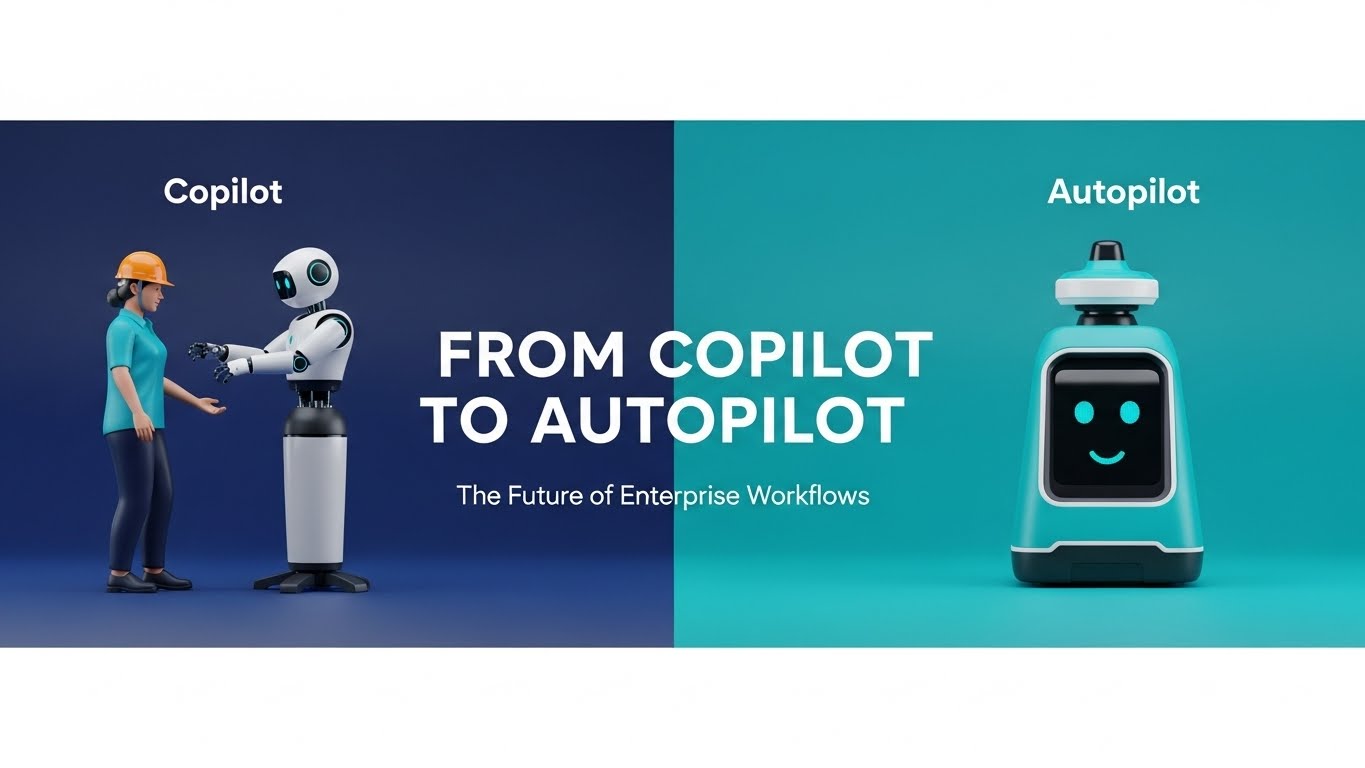
But hold onto your ergonomic office chairs, folks, because 2025 has decided that interns are so last year. We are now entering the era of the Autonomous Agent. We are shifting from "Copilot"—where you are the pilot sweating through turbulence while the AI hands you a map—to "Autopilot," where you (theoretically) sip a martini in the back while the AI flies the plane, lands it, and files the expense report for the fuel.
Letʼs dive into what this shift actually looks like, why itʼs terrifyingly exciting, and how to survive the transition without accidentally letting an AI purchase a small island in the Pacific with your company card.
The "Copilot" Trap: Why Assistance Isn't Enough
Donʼt get me wrong, Copilots are great. Theyʼre fantastic at the "human-in- the-loop" model. You ask a question; it gives an answer. You ask it to draft code; it gives you code (which you then spend three hours debugging, but hey, it tried).
The problem with Copilots is the "Co" part. It implies you are still doing the heavy lifting. You are the bottleneck. A Copilot waits for your prompt like a loyal dog waits for a tennis ball. If you don't throw the ball, the dog just stares at you. In an enterprise setting, this leads to what I call "Prompt Fatigue"—the existential dread of realizing your job has become nothing but thinking of creative ways to ask a robot to do your job.
Enterprises have realized that having 10,000 employees spending 2 hours a day prompting AI isn't "automation." It's just a really high-tech version of micromanagement.
Enter the Autopilot: The "Agentic" Revolution
The industry buzzword youʼll be hearing until your ears bleed is "Agentic AI." Unlike a chatbot that talks, an Agent does.
Think of the difference this way:
- Chatbot (Copilot): "I found five potential leads for you. Here is a list."
- Autonomous Agent (Autopilot): "I found five potential leads, researched their tech stack, drafted personalized outreach emails based on their recent LinkedIn posts, sent them, scheduled a follow-up for Tuesday, and updated the CRM. Also, I ordered you a pizza because you looked stressed."
This shift is fundamental. We are moving from Conversation-Based interfaces to Goal-Based outcomes. You don't tell the autopilot how to fly; you just tell it where to go.
The 3 Stages of Letting Go (And Trusting the Machine)
1. The "micromanagement" Phase
You deploy your first autonomous agent to handle, say, invoice processing. You, being a responsible human, set it to "Semi-Autonomous" mode where you have to approve every single action. You spend your entire day clicking "Approve" on 5,000 invoices. You realize you have effectively become the API.
2. The "Hold My Beer" Phase
Exhausted, you decide to remove the human approval step for transactions under $50. The agent processes them instantly with 99.9% accuracy. You feel a surge of power. You raise the limit to $500. Then $5,000. You are drunk on efficiency. You start looking at other departments. "Can we automate HR?" you whisper. "Can we automate... the CEO?"
3. The "Shadow IT" Panic
Suddenly, you realize you have 50 different agents running across the company. The Sales Agent is fighting with the Marketing Agent over lead attribution. The Customer Support Agent just promised a refund policy that doesn't exist. You realize that managing a workforce of digital agents is suspiciously similar to managing a workforce of humans, except these ones work at the speed of light and don't drink coffee.
Real-World Use Cases (That Actually Work)
Letʼs look at where this is actually happening, beyond the hype.
The Self-Healing Supply Chain:
Instead of a dashboard blinking red when a shipment is delayed (requiring a human to frantically call a vendor), autonomous agents now detect the delay, check the inventory levels, identify an alternative supplier, negotiate a price (within pre-set guardrails), and re-route the shipment. The human manager just gets a notification: "Fixed it. You're welcome."
The Zero-Touch Customer Service:
We aren't talking about those "Press 1 for frustration" phone trees. We're talking about agents that can perform actions. A customer says, "I want to upgrade my plan." The agent doesn't send a link to a help article; it authenticates the user, processes the payment, updates the database, sends the confirmation, and provisions the new service. No human involved. No "let me speak to your manager."
The Risks: When Autopilot Becomes a Kamikaze
Of course, handing the keys to the machine isn't without risk. The biggest fear in the "Autopilot" era is the Feedback Loop from Hell.
Imagine two autonomous pricing agents from competing companies. Agent A lowers the price to capture market share. Agent B lowers it further to compete. Agent A responds. Within 4 seconds, both companies are selling their flagship product for $0.01. Great for the consumer; terrible for your quarterly earnings call.
To survive this transition, you need Governance (boring word, critical concept). You need "Agent Constiutions"—hard-coded rules that the AI cannot break, no matter how "optimal" it thinks a solution is. Rule #1: Do not give away the company for free.
How to Prepare Your Organization (Without Crying)
If you want to move from Copilot to Autopilot, here is your survival guide:
- Stop training people to prompt; start training them to orchestrate. Your employees shouldn't be writers; they should be editors and managers of AI fleets.
- Audit your data silos. An autonomous agent is only as good as the data it can access. If your sales data is on a sticky note in Bobʼs cubicle, the agent will fail.
- Start small, but think autonomous. Don't just automate a task; automate a decision. Start with low-risk decisions (scheduling, data entry) and work your way up to the big leagues.
Final Thoughts
The transition to autonomous enterprise workflows is inevitable. The efficiency gains are just too massive to ignore. But letʼs not forget the most important rule of automation, coined by yours truly: "To err is human; to completely destroy a database in 3 milliseconds requires an autonomous agent."