Wi-Fi 8 Explained: The Next Big Leap (That Isn't About Speed)
Let’s play a quick game of word association. When I say "Wi-Fi," what do you think of? "Magic air internet?" Sure. "Netflix?" Obviously. "Why is it buffering, I am literally sitting on top of the router?"
Bingo.
For the last two decades, the wireless industry has been obsessed with one thing: Speed. Every new Wi-Fi box promises to be faster, blasting gigabits into your face like a firehose. And yet, here
we are in 2026, still toggling our phone’s Wi-Fi off and on because the signal dropped in the guest
bathroom.
Enter Wi-Fi 8.
Technically known as IEEE 802.11bn (a name only a mother could love), Wi-Fi 8 is making a
radical pivot. It doesn’t care about making your internet faster . It cares about making it work .
Buckle up. We’re diving into the "Ultra High Reliability" future where your internet connection
might finally be as stable as a wired cable—or at least more stable than my diet plans.
Wait, No Speed Upgrade? Are You Serious?
I know, it sounds like heresy. Wi-Fi 7 (which you probably just bought) was all about "Extremely
High Throughput." It promised speeds up to 46 Gbps, which is enough to download the entire
internet in the time it takes to sneeze.
Wi-Fi 8 looks at those speeds and says, "Yeah, we're good there."
The reality is, nobody needs 50 Gbps on their iPad. What we do need is for the iPad not to
disconnect when the microwave runs. Wi-Fi 8 is maintaining the same maximum theoretical
speeds as Wi-Fi 7. Instead of adding more lanes to the highway, it’s firing all the bad drivers and
installing a traffic control AI.
The official tagline for the Wi-Fi 8 project is UHR: Ultra High Reliability. If Wi-Fi 7 is a Ferrari that
goes 200 mph but occasionally stalls at stop signs, Wi-Fi 8 is a Rolls Royce that drives smoothly
over potholes while holding a glass of champagne.
The Secret Sauce: How Wi-Fi 8 Fixes "The Flakiness"
So how does this magical stability happen? It’s not just positive thinking. Wi-Fi 8 introduces some
features that force routers to stop acting like selfish toddlers and start cooperating.
1. Coordinated Spatial Reuse (Co-SR)
Imagine you’re at a dinner party. You’re trying to tell a joke, but the guy next to you is shouting a
story about his cat. You can’t hear. You shout louder. He shouts louder. Chaos ensues.
This is how current Wi-Fi works. Your router and your neighbor’s router are constantly screaming
over each other on the same frequency.
Co-SR changes the rules. It allows your router and your neighbor’s router to actually talk to each
other. Your router can say, "Hey, I’m sending a small email, I’ll whisper so you can keep streaming
4K." They adjust their "volume" (power output) dynamically so everyone can talk at once without
interference. It’s the first polite Wi-Fi standard.
2. Coordinated Beamforming (Co-BF)
If Co-SR is volume control, Co-BF is sniper precision.
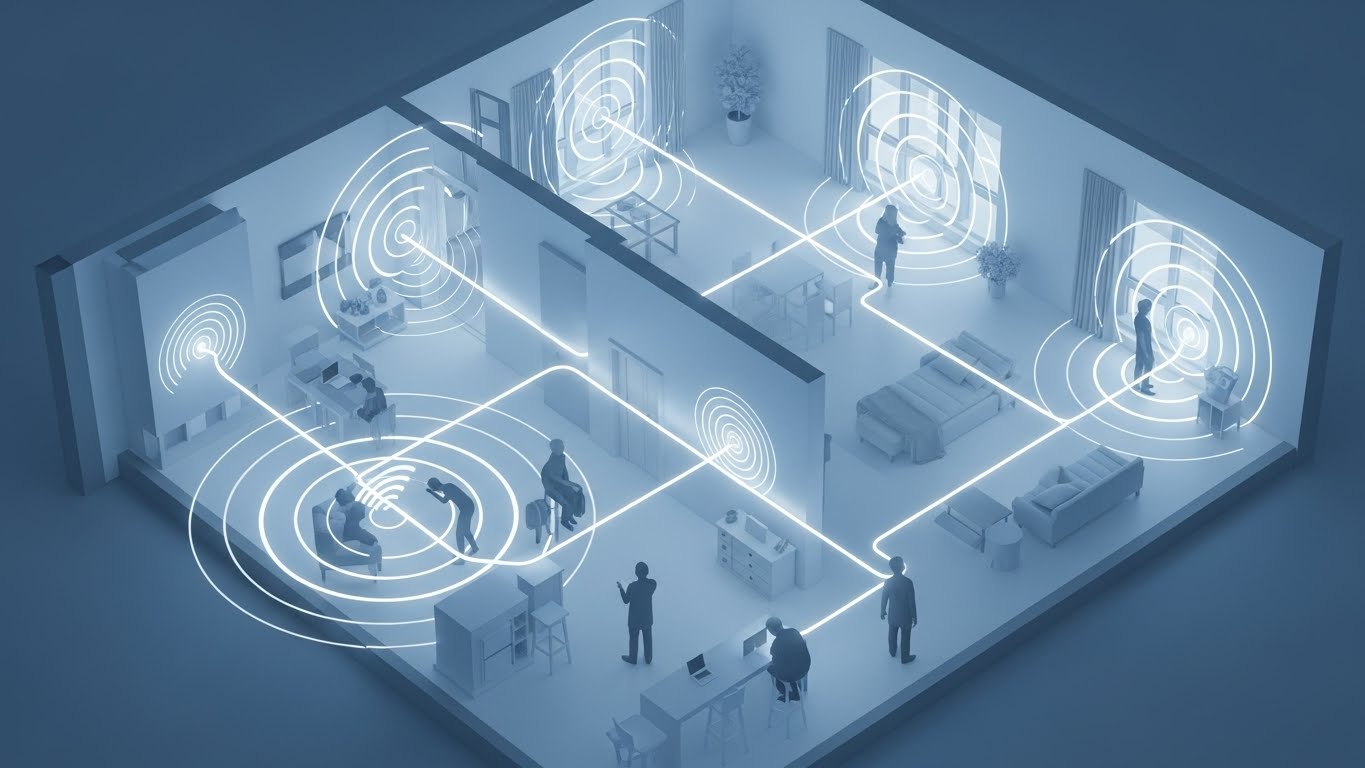
Right now, routers spray signal all over the house like a sprinkler. Beamforming (introduced a
while ago) helped aim that spray, but Wi-Fi 8 takes it to a terrifyingly accurate level. Multiple
access points (like your mesh nodes) can coordinate to shoot data specifically at your device
while simultaneously steering "nulls" (dead zones) toward interference sources.
It’s like your router is dodging bullets for you.
3. Dynamic Sub-Channel Operation (DSO)
This is the nerdy one, but stick with me. Currently, if a high-speed device (like a gaming PC) and a
low-speed device (like a smart lightbulb) are on the same channel, it can cause a traffic jam. The
fast car gets stuck behind the tractor.
DSO allows the network to dynamically assign "lanes" based on what the device needs right now .
It moves the tractor to the slow lane instantly, clearing the fast lane for your headshots in Call of
Duty. No more lag spikes because your smart fridge decided to update its firmware.
Wi-Fi 7 vs. Wi-Fi 8: The Showdown
Since Wi-Fi 7 hardware is currently sitting on store shelves costing a small fortune, you’re
probably wondering if you should return it. Here is the breakdown:
- Wi-Fi 7 (802.11be):
- Focus: Raw, unadulterated speed.
- Best For: People who transfer massive files, VR enthusiasts, and people who like seeing big
numbers on speed tests. - Vibe: "I am speed."
- Wi-Fi 8 (802.11bn):
- Focus: Reliability and latency.
- Best For: Gamers who hate lag, people living in apartment complexes with 500 other Wi-Fi
networks, and anyone who works from home. - Vibe: "I am stability."
When Can I Buy It? (Put Your Wallet Away)
Don’t panic. You don’t need to throw your current router into the ocean just yet.
Wi-Fi standards move at the speed of bureaucracy. The IEEE (the folks in charge of this stuff)
likely won’t finalize the Wi-Fi 8 standard until early 2028. That means we probably won’t see "WiFi 8 Certified" stickers on boxes at Best Buy until late 2028 or even 2029.
However, seeing as how tech companies love money, we might see "Pre-Wi-Fi 8" or "Draft Wi-Fi 8"
routers pop up sooner, costing roughly the same as a used Honda Civic.
The Verdict
For the first time in history, we have a tech upgrade that isn’t about "more." It’s about "better."
Wi-Fi 8 acknowledges a hard truth: We have enough bandwidth. We don’t need to download a
movie in 0.4 seconds instead of 0.8 seconds. We need to walk from the kitchen to the living
room without the video call freezing in a way that makes us look like we’re having a stroke.
So, keep enjoying your Wi-Fi 6 or 7 for now. But look forward to 2028, when we might finally stop
asking, "Is the Wi-Fi down, or is it just me?"