Building a rich text editor from scratch is one of the fastest ways to lose a weekend. Get a <textarea> to support bold, italic, headings, and image uploads, and you'll be fighting cursor jumps, contenteditable quirks, and Safari-specific bugs by lunchtime.
That's why React developers reach for a library instead. For years, Draft.js — Facebook's open-source editor framework — was the default. Today, two newer options dominate the conversation: Tiptap, built on the ProseMirror engine, and Lexical, Meta's own successor to Draft.js.
This guide compares all three honestly — including where each one falls short — so you can pick based on your actual project, not hype.
What React Developers Actually Need in 2026
A modern editor needs to support more than bold and italic. Typical requirements now include:
Embeds — images, videos, code blocks, tweets
Mentions —
@usernametagging (Slack/Reddit-style)Slash commands —
/to open a quick-action menu (Notion-style)Markdown shortcuts — typing
#to create a headingCollaboration — real-time, Google Docs–style editing
Clean data output — structured JSON or HTML, not opaque internal blobs
And because React wants to own the DOM while contenteditable also wants to own the DOM, the library's job is to manage that tension without introducing bugs or performance drops.
Draft.js — The Original Standard
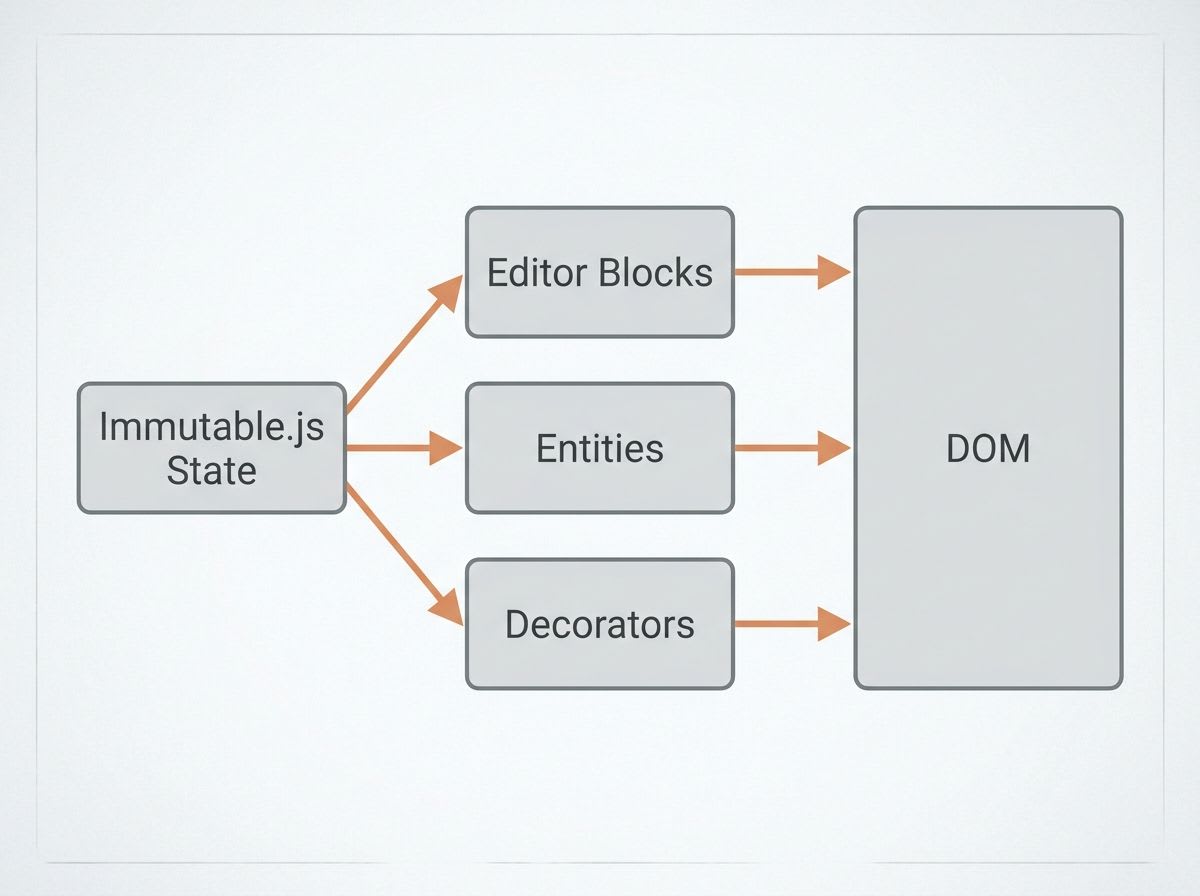
Draft.js was open-sourced by Facebook in 2016 as a structured, React-based way to build editors, using Immutable.js to manage state and giving developers granular control over formatting logic. It became the standard choice for years and still powers legacy products today.
Why it's harder to justify in 2026
1. Steep learning curve. You need to understand entities, decorators, block types, and Immutable.js data structures before you can do much beyond basic formatting.
2. Plugin-dependent, and the plugin ecosystem has stalled. Mentions, emoji pickers, and toolbars are typically third-party plugins, and many of the popular ones (draft-js-plugins, for example) haven't seen significant maintenance in some time — check current activity before depending on one.
3. Weaker mobile behavior. Android predictive text, mobile cursor placement, and input lag have been long-standing, well-documented pain points in Draft.js's issue tracker.
4. No longer actively evolved by Meta. Meta's own investment has shifted to Lexical — see Meta's Lexical announcement for their stated reasoning.
Where Draft.js still makes sense
You're maintaining a large legacy codebase already built on it
Migration cost outweighs the benefit of switching
Your formatting needs are simple and stable, and you're not adding new editor features
Tiptap — The Headless ProseMirror Wrapper
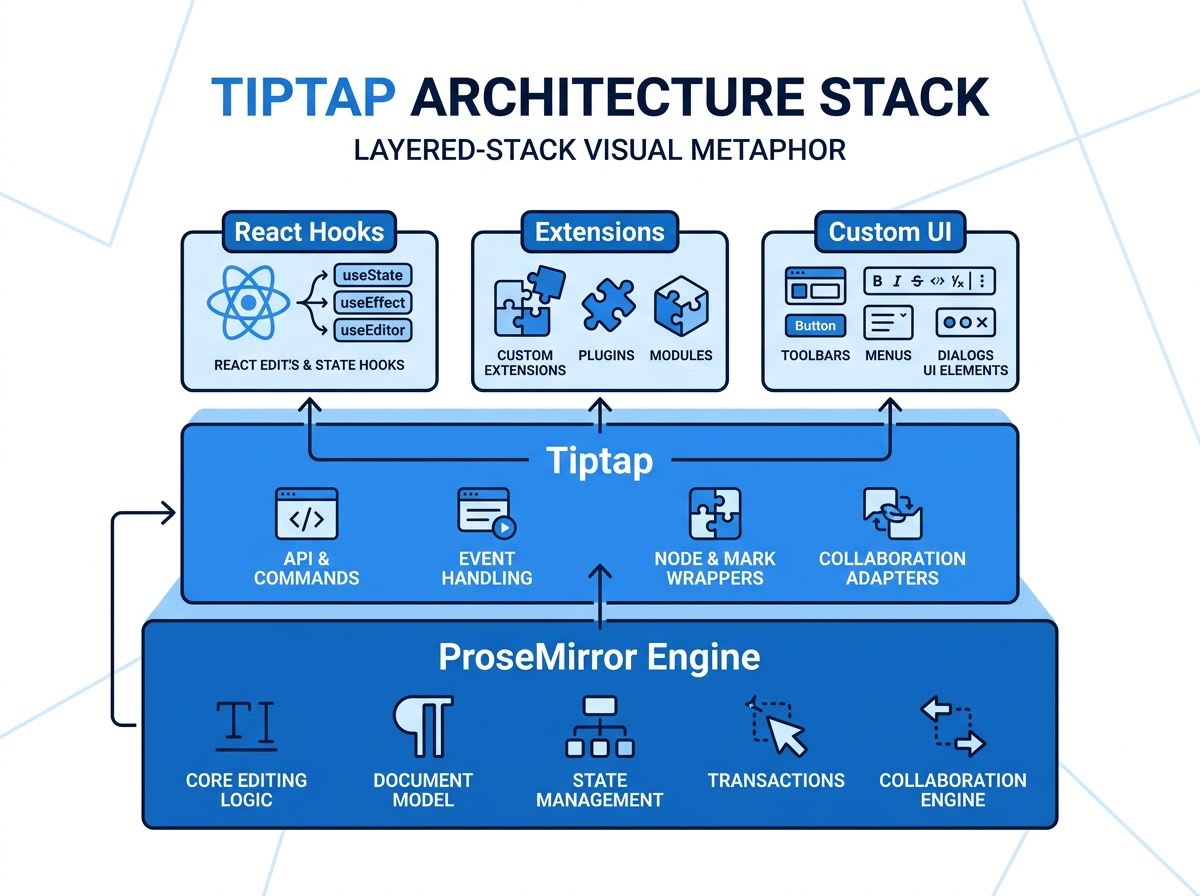
Tiptap wraps ProseMirror — a mature, highly extensible editor engine — in a friendlier, framework-agnostic API with first-class React bindings via @tiptap/react.
Core philosophy: headless
Tiptap gives you editing logic and state, not a prebuilt UI. You build your own toolbar, menus, and styling using React components — nothing is imposed.
jsx
import { useEditor, EditorContent } from '@tiptap/react'
import StarterKit from '@tiptap/starter-kit'

function Editor() {
  const editor = useEditor({
    extensions: [StarterKit],
    content: '<p>Hello World</p>',
  })

  return <EditorContent editor={editor} />
}
What Tiptap does well
Clean, predictable output.
editor.getHTML()andeditor.getJSON()return structured data that's easy to store in Postgres, MongoDB, or Supabase and render server-side in Next.js.A large official extension library — tables, images, mentions, task lists, typography, and Markdown input rules, maintained by the Tiptap team.
Real-time collaboration, via Hocuspocus, a Y.js-based sync server. Note this is a separate piece of infrastructure you self-host or pay for — not something bundled into the editor for free out of the box.
Pairs naturally with Tailwind, shadcn/ui, and Next.js since you control all markup.
Where Tiptap has real costs
To be fair to readers actually deciding between these, Tiptap isn't free of trade-offs:
You build the UI yourself. Headless means no default toolbar or styling — that's a real chunk of work if your team doesn't have frontend bandwidth to spare.
Some advanced extensions are paid (Tiptap Pro / Content AI), including certain collaboration and AI-assisted features — check the Tiptap pricing page before assuming everything is free.
ProseMirror's schema model has its own learning curve once you move past
StarterKitinto custom nodes and marks — it trades Draft.js's complexity for a different kind of complexity, not zero complexity.
Lexical — Meta's Modern Successor to Draft.js
Any honest 2026 comparison has to include Lexical, which is conspicuously often left out of "Draft.js vs X" posts despite being Draft.js's own replacement.
Lexical is Meta's newer editor framework, built with performance and extensibility as first principles, and ships first-class React bindings via @lexical/react — so the common claim that it's "not React-first" doesn't hold up against its own documentation.
Strengths: very small core bundle, strong accessibility defaults, plugin-based architecture, active Meta backing. Trade-offs: younger ecosystem than Tiptap's, fewer third-party extensions currently available, steeper docs for advanced customization.
If you're choosing in 2026, Lexical deserves a place on your shortlist next to Tiptap — particularly if bundle size or Meta-backed longevity matters more to you than Tiptap's larger extension catalog.
(For teams that specifically want a Slate.js comparison too — another headless, React-first, JSON-based option — that's a good follow-up piece; it's outside the scope of this one.)
Performance: What Actually Happens at Scale
Draft.js re-renders through its Immutable.js state model, and in practice this shows up as typing lag and slower rendering once documents get large — a long-standing, documented complaint rather than a hypothetical one.
Tiptap, via ProseMirror, uses fine-grained DOM diffing that updates only the changed portion of the document, which holds up well on large documents. ProseMirror itself is already in production use at companies including the New York Times, The Guardian, and Atlassian, per Tiptap's own package documentation — a useful signal of how the underlying engine performs at scale, independent of Tiptap's own wrapper.
Side-by-Side Comparison
Feature | Draft.js | Tiptap | Lexical |
|---|---|---|---|
First released | 2016 | 2018 (v1) — now on v3, with SSR and JSX support | 2022 |
Engine | Immutable.js | ProseMirror | Custom (Meta) |
React integration | Native, but dated API |
|
|
Learning curve | High | Moderate | Moderate–High |
Mobile support | Historically weak | Strong | Strong |
UI approach | Bundled patterns | Fully headless | Headless |
Official extensions | Sparse, third-party | Large, official | Growing, official |
Collaboration | Custom-built only | Hocuspocus (self-host/paid) | Yjs-compatible, DIY setup |
Active core maintenance | Minimal | Active | Active (Meta-backed) |
Best fit | Legacy maintenance | Custom CMS/apps needing rich extensions now | Performance-sensitive apps, teams wanting Meta-backed longevity |
Real-World Scenario: Building a Blog CMS
Draft.js: more boilerplate for basic formatting, harder content-block styling, image support needs plugins, HTML output sometimes needs cleanup before SSR.
Tiptap: faster initial setup, official extensions cover images/tables/mentions, getHTML() output is SSR-friendly out of the box — but budget real time for building your own toolbar UI.
Lexical: smaller bundle and strong performance, but expect to write more custom plugin code for features Tiptap ships as an official extension today.
Which Should You Choose?
Stick with Draft.js if: you're maintaining an existing app built on it and migration cost isn't justified yet.
Choose Tiptap if: you want the widest range of ready-made extensions today, you're comfortable building your own UI, and you need collaboration features without building sync infrastructure from scratch.
Choose Lexical if: bundle size and raw performance are priorities, you want Meta's long-term backing, and you're fine with a slightly smaller (but growing) extension ecosystem.
There isn't a single universal winner — the right pick depends on whether your bottleneck is extension coverage (Tiptap), performance/bundle size (Lexical), or migration cost (Draft.js, if you're already committed).
Related Reading
Why Choose Tiptap for a Markdown & Rich Text Editor? — a deeper, practical Tiptap + Next.js setup guide
FAQ
Is Draft.js deprecated? It's not officially deprecated, but Meta has shifted its own development focus to Lexical, and third-party plugin maintenance for Draft.js has slowed significantly. Treat it as legacy-stable rather than actively evolving.
Is Tiptap free? Tiptap's core and most extensions are open source (MIT), but some advanced features — including parts of Tiptap Pro and Content AI — are paid. Check the pricing page for current details.
Is Lexical better than Tiptap? Neither is strictly "better" — Lexical tends to win on bundle size and performance; Tiptap tends to win on the breadth of ready-made official extensions. The right choice depends on your project's priorities.